Locks explained
Mortice Deadlocks: 5 Lever, BS 3621 and Sashlocks
A mortice deadlock is a lock body set into the edge of a timber door and locked with a lever key. On a final exit door, insurers usually want a 5 lever lock to BS 3621, marked with the Kitemark. A sashlock adds a handle-worked latch. Fitted, a BS 3621 deadlock costs £100 to £205 (MLA price list, Checkatrade, MyJobQuote and Bark).
What is a mortice deadlock?
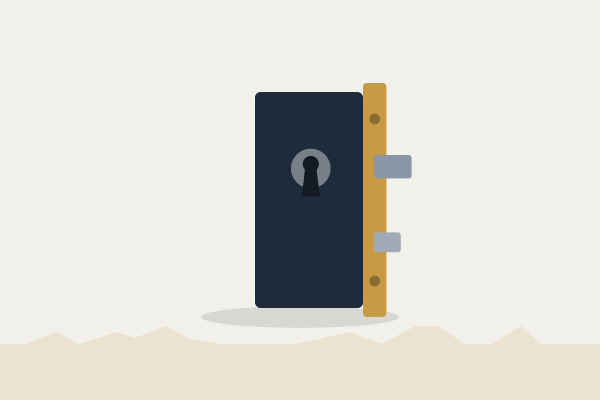
"Mortice" describes how the lock is fitted: into a pocket cut in the door's edge, rather than screwed to its face. A deadlock throws a solid bolt into the frame that cannot be pushed back without the key. It is worked by a lever key, with a round stem and a flat bit cut in steps. A 5 lever lock has five levers inside, which is the count the British Standard expects. Mortice deadlocks are the main lock on many timber front and back doors in older UK homes, often paired with a night latch higher up the door.
What is the difference between a deadlock, a sashlock and a mortice latch?
- Mortice deadlock: a key-worked bolt only. There is no handle, so the door needs another latch to stay shut. - Mortice sashlock: the deadbolt plus a sprung latch worked by a handle, in one case. Common on back doors. - Mortice latch: a sprung latch worked by a handle with no key at all. It keeps an internal door shut and is not a security lock.
Cases come in standard depths, usually about 64 mm or 76 mm, so a like-for-like swap is simple, while a different size means cutting the door. For bathroom versions, see the internal door locks page.
What does BS 3621 mean on a mortice lock?
BS 3621 is the British Standard for thief-resistant locks worked by a key. A compliant lock shows the Kitemark and "BS 3621" stamped on the faceplate. The test covers resistance to drilling, forcing and manipulation, and the number of different keys the design allows. For homes where people must get out without a key, BS 8621 allows keyless exit from inside, and BS 10621 is a variant meant for buildings with another way out, not single-exit homes. Home insurers often ask for a BS 3621 lock on timber final exit doors, though wording varies between policies.
How can you tell what mortice lock you have?
Open the door and look at the faceplate on its edge. A Kitemark and "BS 3621" mean the lock meets the standard; the words "5 lever" on their own do not prove it. Count the holes in the door face: one keyhole and no handle spindle means a deadlock, while a keyhole below a square spindle hole means a sashlock. If you plan to order a replacement, measure from the faceplate to the centre of the keyhole, known as the backset. Older locks may be 2 or 3 lever, which insurers rarely accept on a front door.
What does a mortice lock cost fitted, and when do you call a locksmith?
A BS 3621 mortice deadlock costs £100 to £205 fitted, a range drawn from the MLA price list, Checkatrade, MyJobQuote and Bark (checked October 2026). A like-for-like case swap sits at the lower end; recutting a door for a different size takes longer. Call a locksmith when the key turns but the bolt will not throw, when keys are lost or stolen, when a lock must meet an insurer's condition, or after a break-in has damaged the frame. Ask for the standard on the invoice. If a lockout means a mortice lock has to be drilled, MyJobQuote puts the job with a new lock at £180 to £300.
Common questions
Is a 5 lever lock the same as BS 3621?
Not always. Most BS 3621 locks are 5 lever, but a 5 lever lock is not automatically BS 3621. Look for the Kitemark and the standard number stamped on the faceplate.
Can I fit a mortice lock on a uPVC door?
Generally no. uPVC and composite doors use a multipoint mechanism worked by a euro cylinder, and the security grade sits on the cylinder: TS 007 3 star or SS 312 Diamond.
Why does my insurer ask for BS 3621?
It is the British Standard insurers use as a benchmark for key-locked locks on timber doors. Many policies name it for final exit doors, so a lock without it can affect a claim.
What is a sashlock used for?
A sashlock is a mortice deadlock with a handle-worked latch built in. It suits back and side doors, where you want the door to latch shut during the day and lock with a key at night.